
Information is fragmented
Activities are spread across websites, posters, newsletters, WhatsApp groups and personal networks.
For social and community organisations
Close helps social and community organisations make local opportunities more visible, easier to join and more connected to the everyday lives of residents.
Public-benefit oriented · Built around trusted local partners · Aggregated impact signals

Starting point
Activities are spread across websites, posters, newsletters, WhatsApp groups and personal networks.
Residents who are new, isolated or less connected often struggle to discover what is already available nearby.
Teams and local providers do valuable work, but visibility and activation remain limited in everyday life.
A listing can inform people, but it rarely creates the small first step into participation.
Programme leads and funders often lack simple, aggregated signals about use, gaps and local momentum.
How Close helps
Close brings local activities, places and opportunities for connection into one trusted platform. Residents can discover relevant options nearby, while organisations can publish offers without managing yet another complex channel.
Groups, courses, open sessions and recurring formats become easier to find.
Community centres, advice points, cafes and trusted local places receive a clear profile.
Walks, coffee meet-ups and open groups can become simple entry points into local life.
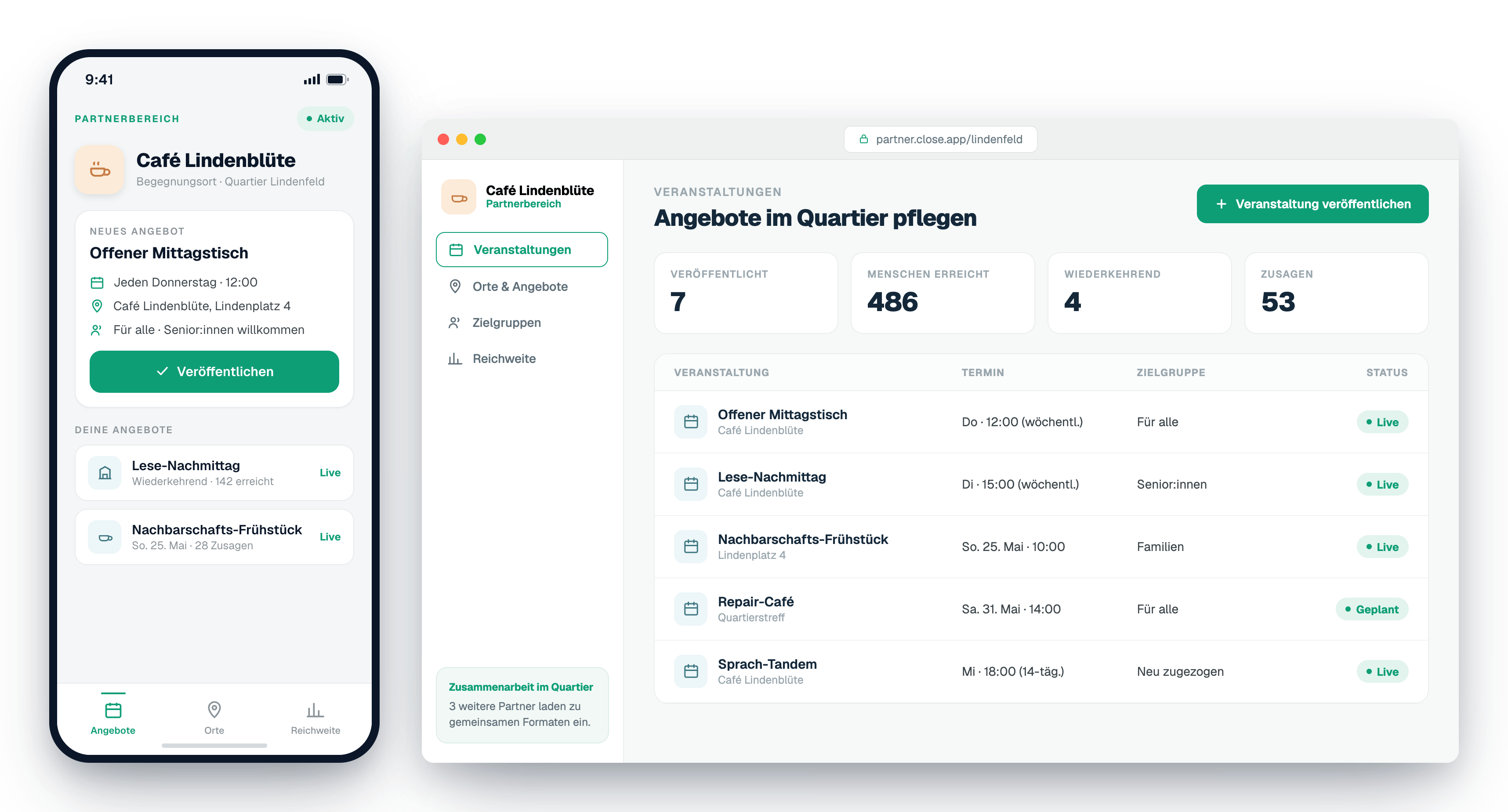
Local organisations can maintain their own content without learning an enterprise system.
Coordinators see offers, places and activity patterns across a neighbourhood or programme area.
Usage, offer density and engagement become visible as aggregated, privacy-conscious signals.
Value
Existing groups, courses, meeting points and activities become discoverable without every provider having to maintain separate channels.
Close is useful where conventional communication is not enough: new residents, people living alone or people without strong local networks.
Providers, local teams and partners gain a shared view of activities, places and momentum in the neighbourhood.
The platform is not only about information. It helps residents take the first step into small, approachable local activities.
Dashboards and reports show which offers are used, where gaps remain and how local activity develops over time.
Platform logic
Close can reflect different organisational structures. On the public website we use plain language: lead organisation, neighbourhood or programme area, and local partners. In the CMS, this can be represented as tenant, space and partner organisation.
For example a social provider, community organisation, foundation, municipality or programme lead.
For example a district, neighbourhood, local service area, programme area or cluster of sites.
For example community centres, advice services, clubs, cafes, faith groups, initiatives or meeting places.
Use cases
Local activities, partners and engagement become visible for practical coordination.
Close creates approachable routes into groups, places and everyday contact.
Open hours, programmes and recurring formats become easier for residents to find.
Offers for different age groups can be discovered in one local context.
Language cafes, advice sessions and open groups can reach people beyond existing networks.
Movement, social activation and prevention formats can be connected to local participation.
Aggregated signals help teams discuss reach, gaps and development with funders.
Municipal teams, providers and initiatives work from a shared visibility layer.
Funding
Close is not intended to be paid for by individual residents. It is usually scoped with institutions that want to strengthen participation, connection and local activation. Pricing belongs in a concrete pilot conversation, not in a generic webpage.
A social provider funds Close for its own neighbourhoods or sites
A municipality funds Close as infrastructure for community work
A foundation or funder supports a themed local programme
A provider network uses Close together in one programme area
Pilot
A Close pilot can begin in a clearly defined neighbourhood or programme area. The aim is to involve relevant partners, make existing opportunities visible, activate first residents and learn from aggregated participation signals. Close pilots are typically funded through grants, municipal budgets or provider funding we clarify in a first conversation which model fits your situation.
Define the area, target groups, partner structure and first content together.
Local organisations, initiatives and places receive simple access to maintain their offers.
Existing activities, places and recurring formats are imported or created.
Monthly insights show activity, gaps and next activation steps.
A final review summarises learnings and indicates whether further areas make sense.
Close is not designed to replace community work or personal relationships on the ground. It supports existing local work by making opportunities easier to find, easier to join and easier to understand in aggregate.
FAQ
Close fits social providers, community organisations, neighbourhood teams and funded programmes that want to make local opportunities more visible and easier to coordinate.
No. Content can be managed centrally. Partner accounts are useful when local organisations regularly publish their own activities.
Yes. Smaller initiatives often benefit from a trusted local channel instead of having to build and maintain their own reach.
Reporting is designed around aggregated signals. The goal is to understand local activity, not to monitor individual residents.
Yes. A pilot starts with real local offers, partners and activation moments. Usage grows from concrete reasons to participate.
Most pilots are scoped for six to twelve months, depending on area, partner network and funding logic.
Yes. Close is meant to connect and complement existing municipal, social and community structures.
In a first conversation, we clarify the target groups, area, existing offers, possible partners and a realistic pilot scope.